Abstract
The Austrian School of economics maintains that money originated as a high-saleability commodity selected by market forces to reduce barter friction, treating credit as a secondary mechanism backed by pre-existing physical savings. This paper demonstrates that the Austrian foundational model rests on dual empirical and operational fallacies: the myth of commodity money and the myth of absolute physical scarcity. Drawing on A. Mitchell Innes’s credit theory of money, modern balance-sheet mechanics, C.H. Douglas’s Social Credit analysis, and the realities of modern industrial capacity, we show that money has always been credit—a system of clearing debt—and that credit creation precedes both savings and physical production. In a technological era characterized by systemic capacity abundance, holding to gold-standard or loanable-funds assumptions misdiagnoses the nature of financial capital, misunderstands the true drivers of inflation, and severely distorts macroeconomic analysis.
- Introduction: The Austrian Axiomatic Fallacy
The Austrian School of economics—which provides the core economic foundation and theoretical framework for libertarian political philosophy—relies on a sequential, commodity-first premise:
Production/Barter -----> Physical Savings ----> Commodity Money ----> Bank Credit.
In this framework, bank credit not backed 1:1 by prior physical abstinence ("real savings") artificially depresses the interest rate below its "natural" time-preference level, inducing malinvestment in higher-order capital goods.
Because libertarian ideology demands an absolute defence of private property, minimal state intervention, and an unyielding skepticism of public administration, Austrian economics supplies the necessary economic backing: arguing that market processes are self-correcting and that government or central bank interference is the sole cause of economic instability.
This entire deductive superstructure rests on two non-negotiable assumptions:
- Money is a physical medium of exchange that must exist before debt and credit can function.
- The economy operates at or near full physical capacity, making credit expansion a zero-sum redistribution that "steals" real resources from consumer production.
If both premises are false, the deductive foundation of Austrian monetary theory, libertarian policy prescriptions, and their explanation of business cycles logically collapse.
- Mitchell Innes and the Historical Reality of Money as Credit
In his landmark papers What is Money? (1913) and The Credit Theory of Money (1914), diplomat and historian A. Mitchell Innes dismantled the Aristotelian and Mengerian accounts of money evolving from primitive barter.
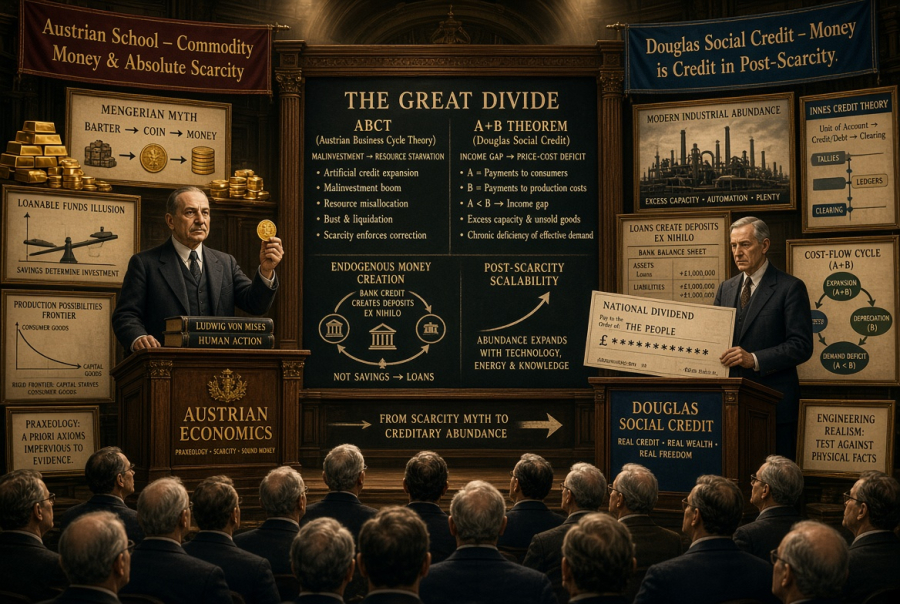
- Mengerian Myth (Austrian/Libertarian): Barter ---> Commodity Selection (Gold/Silver) ----> Coinage ----> Credit/Paper Money
- Historical Reality (Innes): Unit of Account ---> Credit/Debt Obligations ---> Clearing Systems ---> Tokens/Coins
Innes demonstrated through historical and legal records that:
- Money is not a commodity, but a relations-of-debt record: A sale is not the exchange of a commodity for a token of intrinsic value; it is the exchange of a commodity for a credit (a right to cancel a future obligation).
- Coins were tokens, not bullion: Ancient and medieval coins rarely circulated at their metallic value. They functioned as standardized tallies issued by authorities to denote tax obligations and extinguish private debt.
- The Primitive Clearing System: Centuries before formal banking, merchants cleared debts using tallies and credit ledgers. Money existed as an abstract unit of account (e.g., the Livre Parisis or tally stick) long before physical tokens were standardized.
Innes’s central thesis remains unchallenged in modern monetary history: A dollar, pound, or coin is not a piece of wealth, but an acknowledgment of debt. Therefore, credit is not derived from money; money is credit.
- The Accounting Reality: Endogenous Money Creation
The Austrian "loanable funds" model asserts that commercial banks act as mere intermediaries, collecting physical savings from depositors and lending them out to borrowers:
Deposits ---> Loans
Modern central banking operations and double-entry bookkeeping reveal the inverse:
Loans ---> Deposits
When a bank grants a loan, it does not transfer pre-existing currency from a vault or reserve account. It simultaneously expands both sides of its balance sheet:
Assets <---> Liabilities
+ 100,000 Loan (Promissory Note) <-----> + 100,000 Deposit (New Money Creation)
Commercial Bank Balance Sheet Structure:
- Assets: + $100,000 Loan (Obligation of borrower to the bank)
- Liabilities: + $100,000 Customer Deposit (New money created ex nihilo)
Because commercial banks create deposits ex nihilo at the moment of lending, investment is never constrained by a pre-existing pool of physical or financial savings. Instead, loans create deposits, which subsequently generate savings. The Austrian claim that unbacked credit expansion "steals" physical savings is an accounting impossibility.
- The Structural Shift: Post-Scarcity, Industrial Capacity, and Scalability
Austrian Business Cycle Theory assumes a rigid Production Possibilities Frontier (PPF). Under this assumption, expanding capital goods (K) must reduce the production of consumer goods (C).
- Austrian Zero-Sum Assumption (Full Capacity): Capital Goods (K) Consumer Goods (C) (Increasing K inherently starves C )
- Modern Industrial Reality (Excess Capacity): Unutilized Capacity / Technology Scales both K and C simultaneously
In a modern, highly automated industrial economy:
- Permanent Excess Capacity: Industries operate well below full physical capacity. Raw materials, plant equipment, energy, and labor are routinely underutilized.
- Scalability: Industrial production is characterized by falling marginal costs. Generating additional capital equipment does not force the physical liquidation of food, clothing, or shelter.
- Capital-Driven Consumer Surges: Far from starving the consumer sector, periods of capital expansion (K) temporarily boost consumer sales (C). As businesses deploy new credit toward capital construction, a significant portion of those funds flows directly into the economy as immediate income—wages, contractor payments, and operational fees (A costs). This influx temporarily narrows the gap between aggregate consumer income and total consumer goods prices, driving a surge in consumer demand alongside capital growth.
- The Constraint is Demand, Not Supply: The primary limit of modern production is not physical resource starvation or forced consumer sacrifice, but the ongoing financial ability of the market to absorb output at cost-liquidating prices once capital construction finishes and the temporary stream of construction income dries up.
- Macroeconomic Dynamics: The Cost-Flow Business Cycle vs. Austrian Business Cycle Theory
The fundamental divergence between Austrian Business Cycle Theory (ABCT) and the Social Credit framework lies in how each explains the boom-and-bust cycle. While Austrian theory attributes economic crises to central bank interest rate manipulation, C.H. Douglas’s theorem identifies the driver as a structural financial imbalance between income generation and capital overhead accounting.
- Austrian View (ABCT): Artificial Low Interest Rates ---> Over-Investment (Malinvestment) ---> Resource Starvation ---> Bust
- Social Credit View ( Dynamics): Capital Expansion (Income Influx) ---> Construction Ends ---> Depreciation Charges Hit Prices ---> Demand Deficit Bust
Production Precedes Demand: The Reality of Forecast Risk
At an operational level, modern industrial production must precede demand—especially when bringing entirely new products to market. Because demand forecasts are inherently probabilistic rather than deterministic, it is entirely possible for an enterprise to manufacture physical goods that consumers ultimately do not want or buy.
However, where Austrian theory misinterprets this as an artificial distortion caused by bank interest rates ("malinvestment"), Social Credit identifies a far deeper institutional flaw in how purchasing power is distributed.
"Economic Sabotage" and the Glitch of Employment-Based Distribution
In Social Credit analysis, producing goods that consumers do not want or cannot buy is recognized as a fundamental structural glitch known as economic sabotage (the deliberate or systemic waste of human effort and physical resources).
Flawed Systemic Incentive Chain:
- Shortage of Consumer Purchasing Power (A < A+B)
- Government/Industry Forces "Full Employment"
- Production of Unwanted/Redundant Goods ("Economic Sabotage") to generate A-costs/wages so consumers can buy other goods
This waste occurs because the economic system operates under a false premise: treating the primary objective of industry as providing employment to distribute income, rather than simply delivering desired goods and services.
- The Forced Employment Trap: Because the accounting system creates a chronic shortage of consumer income relative to prices (A < A+B), society forces new production cycles—and builds redundant or unneeded goods—merely to distribute wages (A).
- The "Wrong Things": Workers are forced to produce items that may fail in the market just so they can receive the income required to purchase basic necessities.
- Compounding Depreciation: When an unwanted product fails, its unliquidated overhead and capital costs (B) do not magically vanish; they remain on enterprise balance sheets as bad debt or are written off across corporate structures, further burdening the overall price system.
The Anatomy of the Cost-Flow Cycle
Tracking the chronological transition from capital expansion to final output reveals how the cost-flow deficit generates the business cycle regardless of whether production hits or misses consumer demand:
- The Expansion Phase (The Temporary Income Illusion): During a period of heavy capital expansion (e.g., building a factory or developing new product lines), credit is injected into the market. A substantial portion flows directly as wages and contractor payments (A costs). Because final goods from this new project have not yet hit the market, consumers use this income stream to buy existing goods, temporarily masking the underlying cost-flow deficit.
- The Completion Phase (The Inflow of Overhead Costs): Once construction finishes, the stream of direct construction income (A) dries up. Simultaneously, the new capital equipment enters service, and its development costs enter final prices as depreciation charges—a pure B cost.
- The Bust Phase (The Price-Cost Deficit): Depreciation expenses and loan servicing are added onto final consumer goods prices (A+B). The market now faces an expanded volume of final goods carrying heavy capital depreciation, met by a diminished stream of current consumer income (A).
If the new products turn out to be the "wrong physical things" due to probabilistic forecasting errors, the crisis is merely compounded—consumers refuse the unwanted goods, while lacking the aggregate income to absorb even the goods they do want.
Comparing ABCT and Social Credit Business Cycle Theories
|
Dimension |
Austrian Business Cycle Theory (ABCT) |
Social Credit (A+B Theorem) |
|
Primary Cause of Bust |
"Malinvestment" induced by artificially low interest rates |
Structural gap between current income (A) and capital depreciation costs (A+B) |
|
Diagnosis of Unwanted Goods |
Blamed on central bank credit distorting the natural rate of interest |
Diagnosed as economic sabotage caused by forcing employment to distribute income |
|
Role of Credit |
Distorts relative prices and misallocates physical resources |
Temporarily fills the purchasing power deficit, but creates compounding future debt-costs |
|
State at Capital Completion |
Physical shortage of consumer goods due to resource diversion |
Abundance of consumer goods, but price-cost recovery fails due to income scarcity |
|
Downturn Diagnosis |
Necessary "cleansing" to liquidate bad physical investments |
Systemic clearing failure where distributed income is insufficient to cover aggregate prices |
|
Policy Prescription |
Deflation, ending credit expansion, returning to hard money |
Direct consumer purchasing power injections (National Dividend, Compensated Price) |
- The Misdiagnosis of Inflation: Cost-Push Mechanics and the Fallacy of Central Bank Money Creation
The Austrian School diagnoses inflation as a purely monetary phenomenon—a classic case of "too much money chasing too few goods" initiated by central banks. In the Austrian narrative, central banks print money out of thin air, inject it into commercial banks, and banks then multiply these reserves into loanable funds, inflating the money supply and diluting currency value.
This diagnosis misinterprets both the operational mechanics of money creation and the structural impact of technological progression on price formation.
The Refutation of the Money Multiplier Model
The traditional Austrian model relies heavily on the Money Multiplier Theory, which assumes a sequential, central-bank-driven chain of events:
Central Bank Reserves Created ---> Banks Loan Reserves ---> Deposits Multiplied ---> Inflation
In reality, modern monetary systems operate in exact reverse. As detailed in the Bank of England’s landmark 2014 quarterly bulletin, Money Creation in the Modern Economy (McLeay, Radia, and Thomas):
"Rather than banks receiving deposits when households save and then lending them out, bank lending creates deposits. In the modern economy, most money is created by commercial banks making loans... The reality of how money is created today differs from the description found in economics textbooks: Central banks do not restrict the amount of money in circulation by driving the quantity of high-powered money."
- Austrian / Textbook Myth (Exogenous / Money Multiplier): Central Bank Reserves Commercial Bank Loans New Deposits Created
- Operational Reality (Endogenous Credit): Commercial Bank Loans New Deposits Created Banks Seek Reserves for Clearing
- Loans Precede Reserves: Commercial banks do not wait for central bank reserves before making loans. When a bank evaluates a creditworthy borrower, it extends the loan by creating a corresponding deposit ex nihilo.
- Reserves are Sought After the Fact: Central banks do not artificially cap lending via reserve requirements; rather, they supply reserves on demand to ensure the interbank clearing system functions smoothly and the target policy rate is maintained.
The Abandonment of Reserve Requirements
Because credit creation is endogenous—driven by demand from solvent borrowers and private commercial bank risk assessments—reserves do not control the money supply.
Recognizing that reserve requirements fail as a quantity-control mechanism over money creation, major central banks globally have progressively abandoned required reserve ratios altogether. Jurisdictions including Canada (1992), the UK, Australia, New Zealand, and the U.S. Federal Reserve (which reduced its reserve requirement ratio to 0% in March 2020) manage monetary policy by targeting price (short-term interest rates) rather than attempting to artificially restrict the quantity of money through reserve ratios.
The Austrian claim that inflation originates from central banks "flooding" commercial banks with reserves, which are then "multiplied" into the economy, is operationally and institutionally false.
The Shift in Cost Structure (A vs. B )
If inflation is not simply central bank reserve-pushing, where does persistent price inflation originate in an industrial economy? In a capital-intensive system, inflation is primarily cost-push, driven by structural policy attempts to maintain employment levels against relentless technological labor displacement.
In C.H. Douglas's framework, total production costs consist of:
- A Costs: Direct income paid to individuals (wages, salaries, dividends).
- B Costs: Overhead, capital depreciation, debt charges, and inter-factory payments.
As technology advances, capital automation continuously replaces human labor, altering the ratio between and costs per unit of output:
Technology Shift ---> | A Costs (Direct Wages) and | B Costs (Overhead & Depreciation
Because total prices must cover A+B for firms to remain solvent, the continuous substitution of capital for labor causes B costs to grow rapidly relative to A. Consequently, direct consumer income (A) shrinks as a proportion of total cost-liquidating prices (A+B).
The Full-Employment Policy Dilemma
To counteract the resulting deficiency in consumer purchasing power and stem rising unemployment, modern industrial policy enforces full employment as a primary mandate. The economic apparatus attempts to pump purchasing power into the market by artificially maintaining or expanding through job creation, wage subsidies, or expansionary credit for new production.
Full-Employment Policy Loop:
- Technological Automation ---> A Drops relative to B ---> Purchasing Power Deficit
- Government/Policy Props Up A
- Higher Production Costs (A+B)
- Cost-Push Inflation (Rising Prices)
- Forced -Cost Inflation: To keep consumer income (A) high enough to clear output, policies incentivize firms to maintain payrolls and raise wages despite automation.
- Compound Price Accumulation: Because wages (A) are treated by enterprises as a cost of production, artificially propping up A directly increases the total cost base (A+B).
- Escalating Output Prices: Instead of allowing technological automation to reduce consumer prices, final prices (A+B) continuously rise as firms pass their high fixed overhead (B) and subsidized wage bills (A) directly onto the consumer.
- Conclusion: Methodological Apriorism vs. Engineering Realism
Praxeology and the Refusal of Empirical Testing
At the root of the Austrian School's flawed conclusions regarding money, inflation, and the business cycle lies its fundamental methodology: praxeology (the deductive study of human action). Spearheaded by Ludwig von Mises, the Austrian methodology explicitly rejects the scientific method, empirical testing, and statistical verification in economic theory.
Mises asserted that economic laws are self-evident, a priori truths derived purely through logical deduction rather than observation (Mises, 1949). In Human Action, Mises explicitly dismissed the relevance of empirical experience or real-world data in validating economic theory:
"Its statements and propositions are not derived from experience. They are, like those of logic and mathematics, a priori. They are not subject to verification or falsification on the ground of experience and facts... No special experience is needed in order to comprehend these theorems, and no experience, however rich, could disclose them... The ultimate yardstick of an economic theorem's correctness or incorrectness is solely reason unaided by experience." (Mises, 1949, pp. 32, 64)
By insulating its theories from empirical falsification, the Austrian School relies entirely on internal logical consistency. When Austrian predictions—such as the claim that credit expansion must produce physical resource starvation or runaway consumer hyperinflation—fail to materialise in real-world data, Austrians do not adjust their premises. Instead, they argue that real-world economic facts are too complex to prove or disprove an a priori deduction (Mises, 1949).
This dogmatic reliance on pure deduction creates an uncorrected feedback loop: false starting premises (such as money originating as a barter commodity or banks lending pre-existing physical savings) are logically processed to yield fundamentally erroneous macroeconomic conclusions regarding business cycles and inflation.
- Austrian School (Praxeology / Apriorism): A Priori Axioms ---> (Pure Logic) ---> Economic Theorems ---> Impervious to Real-World Evidence
- Engineering Realism (C.H. Douglas): Physical Universe / Facts ---> (Observation) Systems Analysis ---> (Real-World Test) ---> Operational Verification
C.H. Douglas and the Canon of the Universe
In stark contrast to Austrian apriorism, Clifford Hugh Douglas approached economics not as a philosophical or ideological discipline, but as a formal systems engineering problem. As a trained industrial engineer, Douglas insisted that economic theories must be continuously tested and verified against observed physical facts—what he termed the "canon of the universe" (Douglas, 1920).
For Douglas, an economic system was simply a physical setup designed to achieve a specific objective: delivering desired goods and services with the least expenditure of human effort and material resources. If a financial accounting system produces persistent poverty amidst physical capacity, chronic debt burdens, or recurring trade wars, an engineer does not defend the abstract axioms of the system; they recognize a structural accounting glitch in the machinery and adjust the mechanism to match observed reality.
As Douglas wrote in Credit-Power and Democracy:
"Systems were made for men, and not men for systems, and the interest of man which is paramount is the self-expression of his individuality... Progress is primarily a matter of adjusting mechanisms to reality, not forcing human society to conform to static abstract assumptions." (Douglas, 1920, p. 18)
Summary
The Austrian School’s analysis fails because its baseline premises are historically, operationally, and macroeconomically invalid:
- Money was never a physical commodity evolved from barter; as Mitchell Innes proved, it has always been a creditary accounting system for clearing debt.
- Banks do not lend saved funds; credit creation is endogenous, proceeding independently of prior physical abstinence, rendering the "money multiplier" and loanable funds concepts obsolete—a reality confirmed by central banks abandoning reserve requirements.
- Physical production is not a zero-sum trade-off in a world of technological abundance and systemic excess capacity; capital expansion temporarily increases consumer purchasing power rather than starving it.
- The business cycle is driven by accounting flow gaps (A+B), where the transition from capital construction income to depreciation expenses creates recurring demand collapses, regardless of whether production forecasting errors or "economic sabotage" occur.
- Inflation is not a simple reserve-printing phenomenon, but a cost-push structural issue driven by full-employment policies attempting to prop up direct wages (A) in an increasingly automated economy where overhead costs (B) dominate total prices.
- Methodological apriorism prevents self-correction: By prioritizing rigid a priori deduction over empirical testing, the Austrian school traps its followers—and libertarian economic policy—in an idealized 19th-century worldview that contradicts modern accounting and industrial reality.
By analyzing financial mechanics through a metal-backed commodity lens and insulating its deductive claims from real-world testing, Austrian economics misinterprets credit as a parasite on savings rather than the primary clearing system of industrial output. In an era of post-scarcity production, money is bounded not by gold or physical savings, but by productive capacity, balance-sheet accounting, and the effective distribution of consumer purchasing power.
----------
References
- Douglas, C. H. (1920). Credit-power and democracy. Stanley Nott.
- Innes, A. M. (1913). What is money? The Banking Law Journal, 30(5), 377–408.
- Innes, A. M. (1914). The credit theory of money. The Banking Law Journal, 31(2), 151–168.
- McLeay, M., Radia, A., & Thomas, R. (2014). Money creation in the modern economy. Bank of England Quarterly Bulletin, 54(1), 14–27.
- Mises, L. v. (1949). Human action: A treatise on economics. Yale University Press.