“Subsidiarity” is the name given to the principle that a central authority should have a subsidiary function, performing only those tasks which cannot be performed at a more local level.

The latest encyclical, Laudato Si, is generating a great deal of heat both inside and outside of the Catholic Church – and more heat than light I am afraid. Instead of discussing the various and, in some cases, quite serious scientific, philosophical, and theological concerns that a number of commentators have raised in reference to it (consider, for example, the following interview with Chris Ferrara:

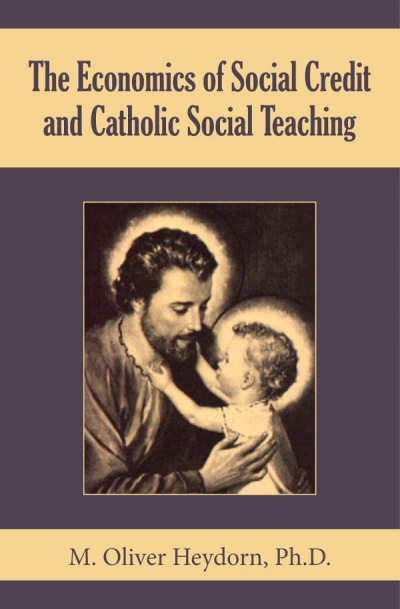
The following review of my booklet The Economics of Social Credit and Catholic Social Teaching was recently published by James Reed in Australia:

Latest Articles

  • The Accounting of Abundance: A Structural Critique of Inflationary Theory
    Mainstream economic thought treats inflation as a phenomenon of monetary volume—the "Too Much Money" paradigm. However, by applying the engineering logic of C.H. Douglas’s A+B Theorem, we can deduce that inflation is not primarily a result of consumer behaviour, but a mathematical consequence of debt-based cost accounting in an industrial society.
    Written on Saturday, 14 February 2026 12:56 Read more...
  • A Douglas Social Credit Critique of Gesell’s Monetary Analysis and Proposals
    Silvio Gesell believed that the two great economic evils were stagnation and inequality. He attributed stagnation to hoarding (the “retention” of money that slows circulation) and inequality to both hoarding and the payment of interest on money. His remedies were therefore twofold: demurrage (a carrying charge that makes money lose value if held, forcing it into rapid circulation) and interest-free credit. From a Douglas Social Credit standpoint, Gesell’s take on monetary reform rests on a fundamentally flawed diagnosis and thus the remedies he proscribes are inadequate, in addition to being coercive and counterproductive.
    Written on Tuesday, 10 February 2026 14:00 Read more...
  • THE THEOLOGY OF THE INHERITANCE: A Social Credit Synthesis of Patristic Thought and Economic Reality
    Social Credit stands alone in its pursuit of the Economics of Grace. It recognizes that the "price" of our life has been paid by the gifts of God and the genius of our ancestors. By replacing the bondage of the gold standard and the indignity of the Job Guarantee with the National Dividend and the Price Discount, we move from an "Economics of Toil" to an Economics of Leisure.
    Written on Tuesday, 10 February 2026 07:54 Read more...